01
Roll
Roll two dice and move your token that many spaces.


Board game
Buy properties. Build your empire. Bankrupt the competition.
Move around the board, buy properties, collect rent, trade, build, and outlast the other players.
Roll the dice, move around the board, buy properties, collect rent, build your color groups, and manage your cash.
You win by being the last player who can still pay. There is no turn limit and no score target.
One turn, from the roll to the player who is still standing.
01
Roll two dice and move your token that many spaces.
02
The space you stop on is what the turn has to resolve.
03
Buy an unowned property at its printed price, or take the space’s action.
04
On your turn, build houses and hotels on a full color set.
05
Collect rent when others land on you. Trade cash, deeds, and jail cards.
06
If you cannot pay, sell buildings and mortgage. Still short, and you are out.
07
The last player who is not bankrupt wins.
Forty spaces. The picture shows the layout. Tax, Go, and Free Parking follow the host.
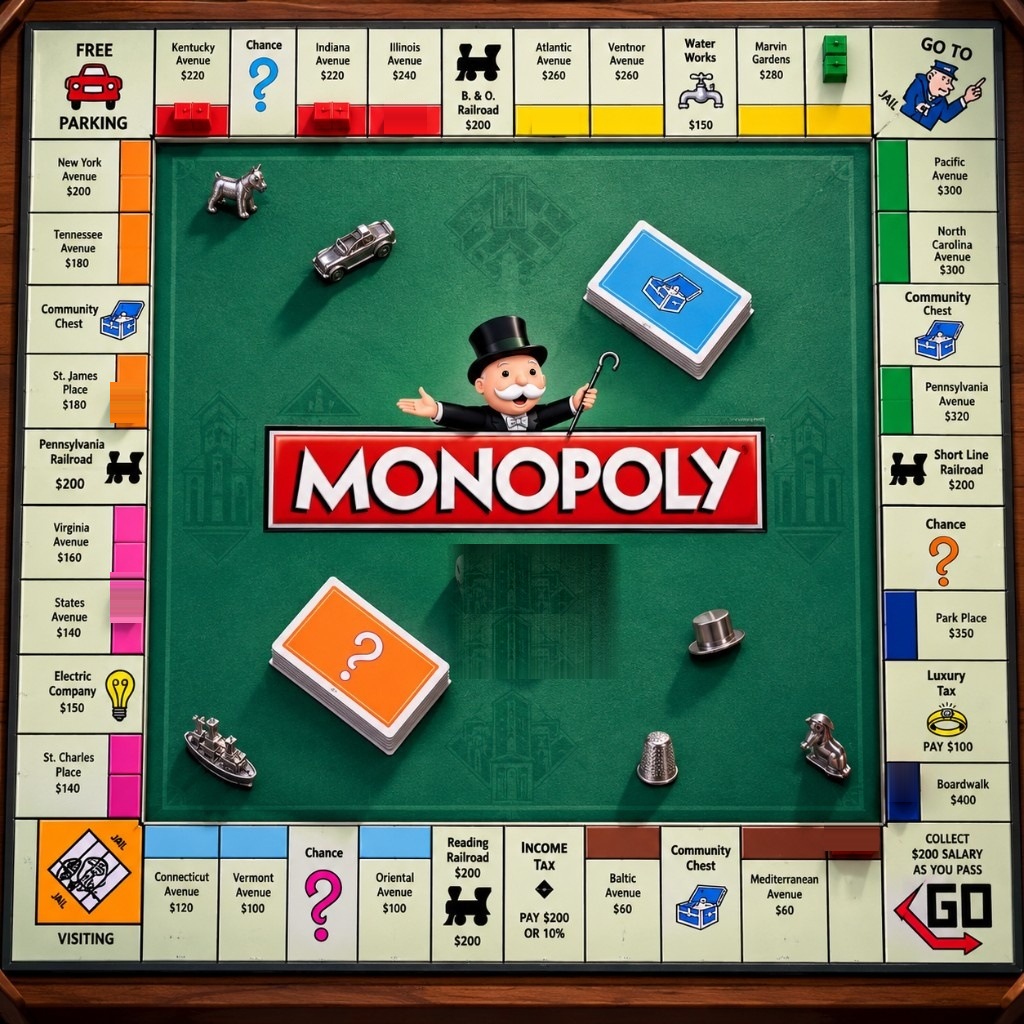
22 streets in eight color groups. Buy them, collect rent, and build once you own the set.
Reading, Pennsylvania, B&O, and Short Line. Each costs $200. Rent is $25, $50, $100, or $200.
Electric Company and Water Works, $150 each. Rent is 4× the dice, or 10× if you own both.
Three spaces. Draw a card. The effect happens immediately, then the card returns to the deck.
Three spaces. Same idea as Chance, with its own 16-card deck.
Income Tax is $200 or 10%, chosen by the host. Luxury Tax is always $100.
Landing here on a normal move is Just Visiting. Being sent here ends your turn.
Passing Go pays the salary. Landing on it pays only if the host left that on.
By default it pays nothing. The host can save taxes and jail fines for whoever lands here.
You jump to Jail. You do not pass Go, and you do not collect the salary.
Printed prices. A mortgage is half. Lifting it costs 10% more, rounded up.
Mediterranean, Baltic
Price $60
House $50
Oriental, Vermont, Connecticut
Price $100–$120
House $50
St. Charles, States, Virginia
Price $140–$160
House $100
St. James, Tennessee, New York
Price $180–$200
House $100
Kentucky, Indiana, Illinois
Price $220–$240
House $150
Atlantic, Ventnor, Marvin Gardens
Price $260–$280
House $150
Pacific, North Carolina, Pennsylvania
Price $300–$320
House $200
Park Place, Boardwalk
Price $350–$400
House $200
Pay the printed price when you land. If you decline, the property is auctioned unless the host turned auctions off.
A clear color set doubles the base rent. Buildings replace that with the rent for that many houses, or a hotel.
Half the printed price from the bank. No rent while it is mortgaged. Unmortgage costs that amount plus 10%, rounded up.
Trade cash, deeds, and jail cards. Auctions bid in steps of $5. The first bid is $5 unless the host requires the printed price.
Open a group for the detail. The short line is the rule that matters.
One ruleset. The lobby changes the numbers. It does not switch you into another game.
The only way Monopoly is played here.
The host sets these in the room. A new room starts on the defaults.
Default 60 seconds. Off, 30, 60, 90, or 120. Off means no clock. Timeout acts for the player, and never buys or builds.
Default Normal. Normal or Fast. This is the dice and token animation. The rules stay the same.
Default on. On lets extra people watch, up to eight. Off means everyone needs a seat before the game can start.
Default $1,500. Any whole dollar amount from $100 to $10,000.
Default $200. From $0 to $10,000. Paid every time you pass Go.
Default on. Passing Go still pays when this is off.
Default off. On pays twice the salary when you stop on Go. Passing stays at the normal amount.
Default $200. The other choice is 10% of cash, unmortgaged property prices, and buildings. Luxury Tax stays $100.
Default nothing. Collect taxes and fees saves income tax, luxury tax, and jail fines for the next player who lands there.
Default on. Off leaves a declined property with the bank. A bankruptcy sale is still auctioned.
Default Normal Purchase: buy at the printed price, or decline. Auction All sends every landing straight to auction and cannot start with auctions off.
Default $0, which means the first bid is $5. Printed price means the first bid must reach the property’s price.
Default off. 10, 20, or 30 seconds per bid. When it runs out, that player passes.
Default on. Bids are always multiples of $5. On means any multiple at or above the minimum. Off means only the next $5.
Default off. On makes the bank the opening bidder. If everyone passes, the bank keeps the property and nobody pays.
2 to 8 seats, default 4. One player per seat. People sit themselves, or the host balances, shuffles, or drafts. That only fills seats.
Bots fill empty seats. They only play legal moves, and they do not call an outside AI.
Buys and bids cautiously, and misses the value of a set.
Buys, builds, and trades while keeping a cash reserve.
Blocks an opponent’s set and leaves an auction earlier.
Tightens auctions and will not hand over a monopoly.
Uses a saved local model when the server has one. Otherwise it plays the same rules brain.
A personality changes how a bot spends: Balanced, Aggressive, Conservative, Trader, Investor, Opportunist, Auction Shark, Tycoon, Banker, Shark, Blocker, Gambler, or Survivor. Bot speed is Fast, Normal, or Slow. That is how long they wait, not how well they play.
Spectators see the board, the cash, the cards, and the bids. They cannot roll, buy, bid, or trade.
Stay solvent. Everyone else has to go broke.
The game ends when one player is left who is not bankrupt. Their cash can be low. They still win.
There is no turn limit, no timer on the whole match, and no win for having the most money while others are still in.
The results screen ranks players by assets: cash, unmortgaged prices, and building cost. That ranking does not decide the winner.
Leaving or disconnecting keeps your seat. The turn clock still runs. Only the host can abandon a live game, and that ends it with no winner.
Start a public game and jump in.